




Paper Mario (N64) — Price Guide & Live Deals
Live US Paper Mario N64 deals across loose carts, CIB and graded sealed: fair asking prices, how to spot reproductions, and what to verify.
Right now: prices easing (-51.5% / 90d), 5 current qualifying listings.
See 5 qualifying listings nowAsking-price ranges by condition
| Condition | Min | 25% | Median | 75% | Max | N |
|---|---|---|---|---|---|---|
| Loose | $70.99 | $76.99 | $79.99 | $79.99 | $89.99 | 6 |
| Cib | $400.00 | $400.00 | $400.00 | $400.00 | $400.00 | 1 |
| Sealed | $40.00 | $40.00 | $40.00 | $40.00 | $40.00 | 1 |
Asking prices of currently-active listings. Not sold-price data.
Is this a good price?
Enter a price to see where it falls among current Loose asking prices for Paper Mario (N64).
How we filter
Of the 1525 listings we observed for this game in the last 30 days, we filtered out 1446 of 1525 (~95%) for quality reasons. The remaining 79 are what we'd actually surface.
- 1407 matched a bootleg / out-of-scope keyword
- 20 seller had too few feedback ratings
- 5 wrong condition (e.g. parts-only)
- 4 RequiredAspect
- 4 priced above the curated ceiling
- 3 priced below our floor (too good to be true)
- 3 seller positive-feedback percentage too low
What this Paper Mario page covers
Live eBay listings for Paper Mario on Nintendo 64 (the US-NTSC 2001 release) — not the Japanese Mario Story original, not PAL European or Australian copies, and not the GameCube sequel Paper Mario: The Thousand-Year Door or any of the later Wii / 3DS / Wii U / Switch entries in the series. The feed sticks to US-NTSC original N64 carts. Paper Mario was developed by Intelligent Systems and published by Nintendo as the spiritual successor to Super Mario RPG: Legend of the Seven Stars (SNES), pairing turn-based RPG combat with the franchise's now-signature flat 2D paper aesthetic layered into 3D environments. Bowser steals the Star Rod from Star Haven, kidnaps Princess Peach and floats her castle into the sky, and Mario sets out to rescue seven Star Spirits and recruit a rotating party of paper partners to take Bowser down.
The N64 cartridge is the original release. The game was later re-released digitally on the Wii Virtual Console (2007) and again on the Nintendo Switch Online + Expansion Pack service (2021); both digital re-releases play the same ROM, with NSO+EP being the currently-active subscription path if you just want to play the game. The market for physical N64 carts is driven by collectors and players who want the original hardware experience — anyone who only wants to play through the story has a cheaper digital route, which sets a soft ceiling on what the loose-cart bucket can ask before the buyer just subscribes to NSO+EP instead.
Use the condition chips at the top of the deal grid to bucket what's surfaced:
- Loose — cartridge only. The most common bucket and what most players buy.
- CIB — complete-in-box: cartridge plus the original outer box, cardboard tray, and instruction manual.
- Sealed — factory-sealed or high-grade encapsulated copies. Almost always graded by WATA / VGA / CGC / PSA.
Asking-price summaries in the table render from the last 24 hours of active US listings — they are seller asks, not realized sales. Treat them as the buyer's negotiating floor, not the appraisal.
Paper Mario variants worth knowing
The substantive variants for Paper Mario N64 are by region and by reprint generation, and the deal feed actively filters non-US copies out:
- US NTSC original print — what this page surfaces. English text, 2001 release year on the cardboard tray, the Star Spirits / Bowser airship cover art on the front of the box.
- US Player's Choice reprint — an early-run retail print and a later Player's Choice budget reprint both exist for many N64 first-party titles; whether Paper Mario received a Player's Choice reprint and how its label or box art differs from the original print is the kind of variant detail collector references answer better than this page does. Listings labeled "Player's Choice" surface alongside original-print copies on this feed; both are authentic US-NTSC releases and the chip filter doesn't separate them.
- Japan (Mario Story / マリオストーリー) — excluded. The Japanese release has a different label, different ROM build (English text replaced with Japanese), and is titled "Mario Story" on the cart — sellers sometimes re-list Japanese copies with "Paper Mario" prepended for searchability, which is why some
Paper Mario Storylistings still surface. The feed's region filter (japan,japanese,jpn,ntsc-j, barejp) catches most but not all. - Europe / Australia PAL — excluded. PAL Paper Mario exists in multiple European language variants and an AUS PAL sub-variant; the feed structurally excludes
pal/eur/auskeywords. - Brazilian Gradiente variant — a rare authorized Brazilian release exists and trades at a significant premium over US copies. Excluded by the feed's pricing band and
gradientenot being in the title token gate, but worth knowing if you see one in the wild.
If you want a non-US copy, search separately — asking prices, in-game language, and shipping landscape all differ by region.
The Japanese Mario Story original retails meaningfully cheaper than US Paper Mario (it's been on the Japan market longer, with more supply), and JP-origin sellers regularly list these as "Paper Mario Mario Story" hoping US buyers won't notice the region until after purchase. If you see a "Paper Mario" listing at significantly below the US loose median, check the title for Story / Mario Story / Nintendo64 (one word) / NTSC-J / bare JP — these are all JP-import tells.
There is no remake of Paper Mario N64. Paper Mario: The Thousand-Year Door (GameCube, 2004) is a direct sequel, not a remake — and got its own remake on Switch in 2024. The original Paper Mario has never been remade or remastered; the closest thing is the Switch Online digital re-release of the same N64 ROM. Listings titled "Paper Mario - Nintendo Switch" or "Paper Mario remake" on a Switch cart are mislabeled, third-party content, or sequels — the deal feed excludes switch, gamecube, wii, gba, 3ds, and sequel keywords (thousand, ttyd, sticker star, origami, color splash, super paper) to keep the surface clean.
Paper Mario: loose vs CIB vs sealed
Loose is the working-collector default and the deepest bucket on this page: a bare cartridge. The spread within the loose bucket comes from cosmetic label condition, save behavior on real hardware, and seller-claimed authenticity. Paper Mario loose carts ask in the mid- to high-double-digits to low-triple-digits for a typical authentic copy. The cart asks meaningfully more than most contemporaneous N64 titles because Paper Mario is held in high collector regard and was relatively low-print versus the launch-window blockbusters (Super Mario 64, Mario Kart 64, GoldenEye).
CIB copies are meaningfully thinner on the market than loose. A Paper Mario CIB typically includes the outer cardboard box, the cardboard insert tray that cradles the cartridge, the instruction manual, and the standard Nintendo paperwork inserts of the era. CIB asks observed on the feed run from the mid-triple-digits into the low-four-digits depending on box condition and insert completeness. The CIB price gradient is driven primarily by box wear (corner crush, label fade, tape residue, sun-bleaching of the spine, indented price stickers from the original retailer) and whether every paper insert is present. Partial CIBs — box + cart but missing the manual or the tray — show up frequently and should price below a true complete copy; listings explicitly noting "no manual" or "missing manual" sit in the CIB-minus tier.
Sealed copies for Paper Mario N64 are almost exclusively graded by WATA / VGA / CGC / PSA at this point. The chip filter on this page surfaces graded sealed copies up to a $2,000 ceiling — enough room for typical mid-grade WATA / VGA copies, but the top-grade tier (WATA 9.2 A+ / 9.4 / CGC 9.6+) trades well above and falls outside this surface. Untouched raw sealed copies (factory-sealed without a grading slab) are rare and command a premium of their own when authenticated; most surfaced "sealed" listings are in graded slabs.
Spotting Paper Mario reproductions and bootlegs
Paper Mario N64 is counterfeited at meaningful volume because the loose-cart asking tier sits in the $100+ range — high enough to make a bootleg cart economically attractive to produce. N64 cart bootlegs tend to be less polished than Game Boy / GBA bootlegs because the N64 cartridge form factor is bigger and harder to fake convincingly than a thumb-sized GBA cart, but the surface still gets a steady stream of "authentic Paper Mario" listings that are actually reproductions. The deal feed filters out listings whose own title says repro, reproduction, or aftermarket (plus the collector-shorthand repo whole-word exclude) — but a dishonest seller listing a bootleg as "authentic" will slip past keyword excludes. The verification work is on the buyer.
The most reliable physical tells, in rough order of reliability:
- Cartridge screw type. Authentic Nintendo 64 cartridges use a specific Nintendo security screw on the back — not a standard Phillips head. A Phillips-head (cross-shaped) screw on the back of a Paper Mario cart means the cart has been opened (legitimate previous work) OR is a bootleg / aftermarket reshell. Phillips on the back is not by itself proof of fake, but it's a flag that the cart's interior is no longer factory-original. Verify against a high-resolution photo of a known-authentic N64 Paper Mario cart before treating screw type as the deciding factor — and don't trust generic "N64 uses screw X" claims from any single source.
- Label print quality and color saturation. Authentic Paper Mario labels have crisp, evenly-saturated multi-color printing with consistent registration. Smudged ink, off-center placement, washed-out colors, label paper that feels too glossy or too matte versus reference, or "newer than the cart" looking labels all suggest aftermarket. Reproduction labels are the single most common N64 counterfeit attack surface; high-resolution comparison against a verified-authentic photo is the most reliable single check a remote buyer can do.
- Cartridge shell color and material. Standard Paper Mario carts use a black plastic shell. Off-color shells (the wrong shade of black, translucent variants, custom colors) almost always indicate a reshell or aftermarket cart — Nintendo did not release Paper Mario in alternate shell colors, and a custom shell pairs with an opened cart by definition.
- Cartridge weight and PCB. If you can request an interior photo (cart open), authentic N64 Paper Mario PCBs have specific component layouts and ROM/save-chip markings that bootleg boards rarely match exactly. Sellers willing to send an interior photo on request are usually the more trustworthy ones.
- Save behavior on real hardware. Paper Mario uses on-cart save memory; many bootlegs save fine in single sessions but fail to retain saves across power cycles, or save in ways that don't preserve all game state (lost partners, lost progression). Ask whether the seller has actually played the cart for more than the first chapter, and confirmed saves persist after power-off across multiple sessions.
When in doubt, ask the seller for a high-resolution photo of the back of the cart showing the screw, the label up close, and (if comfortable) the interior PCB. Sellers who refuse all three are not sellers worth buying from on a N64 Paper Mario cart at the $100+ tier.
There's a Paper-Mario-specific outlier-cheap signal worth noting: listings priced sharply below the loose median frequently turn out to be Japanese Mario Story carts re-titled by the seller, reproductions, or sellers using ambiguous "Story" / "Mario Story" wording in titles that the feed's region excludes don't always catch. A "$30 authentic Paper Mario" listing is the strongest single repro-or-misrepresentation signal short of the seller saying so — Paper Mario carts simply don't trade at that tier in the US-NTSC market for authentic copies.
Save behavior and battery: don't apply Game Boy intuition
A common buyer misconception migrating in from Game Boy and Game Boy Color cart shopping is "old cart = dead battery = lost saves". That mental model does not apply uniformly across N64 carts. Different N64 titles use different save methods — some carts have battery-backed SRAM that DOES go away when the coin cell dies, some use EEPROM that has no battery dependency, and some use the Controller Pak (memory card) for save data. Which method Paper Mario uses is a question better answered against a current PCB-photo reference than from memory — and which method matters meaningfully for buyer-decision pricing on a listing with a stated "tested, saves" vs "won't save" claim.
The buyer-decision-driving question on a 20+ year-old Paper Mario cart is: does the seller's claim that "saves work" actually correspond to the cart's save method working correctly? Sellers who specifically describe their testing — "saved at Toad Town, powered off, came back, save loaded" — are giving you the actionable signal. "Tested" alone without describing what was tested is weaker. If you specifically care about long-term save reliability, ask whether the cart has had any save-chip or battery work done, and treat any specific claim about hardware repair as itself in need of verification (a sticker that says "new battery installed" doesn't tell you which battery, whether the install was clean, or whether the underlying save method is even battery-dependent).
The pragmatic position for most buyers: assume any 20+ year-old cart may need eventual save-system attention, factor that into the price, and don't over-pay for "battery replaced" tags without specific verification of what was actually replaced and why it was needed.
Paper Mario verification checklist by condition
Loose
- Confirm the back-of-cart screw is the original Nintendo security screw (not Phillips). Phillips = opened or aftermarket — ask the seller why before treating it as authentic.
- Look for label condition: tears, water damage, residue from old price stickers, missing label, or signs of label replacement. Compare against a known-authentic Paper Mario label photo.
- Confirm the cartridge shell is the standard black plastic shell (off-color shells are aftermarket).
- Ask whether saves have been tested across multiple power-cycles, and what the seller's specific test was.
- "Authentic" should be stated explicitly; "tested" should specify what was tested.
- Treat any loose Paper Mario asking sharply below the broader market median as a flag for closer inspection — outlier-cheap is the strongest repro-or-misrepresentation signal on this title, and the JP Mario Story import is the second-most-common source of misleadingly-cheap "Paper Mario" listings.
CIB
- Confirm box presence (outer cardboard, not a "replacement box" or third-party acrylic case standing in for the box). The feed actively filters out
replacement boxlistings — these are aftermarket reproductions of the original packaging sold to CIB-assemblers and should not be priced as if they were the original. - Confirm the cardboard insert tray that holds the cartridge — a meaningful piece of "complete" and frequently missing on partial CIBs.
- Confirm the manual is present, not a photocopy or modern reprint. The feed excludes
manual copy,mail order,photocopy, andphoto copylistings, but always verify against the listing photos. - Confirm any paper inserts are present (the standard Nintendo paperwork of the era — specific contents varied by print run, so verify against a reference photo if completeness matters to you).
- Box wear (corner crush, label fade, tape residue, sun-bleaching, indented original-retailer price stickers) drives the spread in CIB asking prices. Sealed-in-protector-case listings can hide box damage behind plastic — request photos of the actual box surfaces, not just the protected presentation.
Sealed
- Almost always graded — verify the grading label is from a reputable house (WATA, VGA, CGC, PSA) and the population report supports the asking price.
- The sealed market is where forgery risk is highest. Counterfeit-PCB carts have been reshelled and re-sealed into convincingly-presented boxes; sealed copies that haven't been through a reputable grading service deserve extra scrutiny.
- The feed's $2,000 ceiling on the Sealed bucket includes typical mid-grade graded copies but cuts off the top-grade investment-tier (WATA 9.2 A+ and higher). For serious sealed buying at the high-grade tier, shop outside this surface.
Paper Mario buying gotchas
- JP Mario Story re-titled as "Paper Mario". Sellers regularly prepend "Paper Mario" to Japanese Mario Story listings hoping US buyers won't notice the region. The feed filters by structured item-location country and excludes
japan,japanese,jpn,ntsc-j, and barejp— but listings that use just "Paper Mario Story" in the title and don't surface the JP region keyword can slip past. If a "Paper Mario" listing is priced significantly below the US loose median, check forStory/Mario Story/Nintendo64(one word) /NTSC-Jtells. - Region confusion: PAL, AUS, Brazilian Gradiente. Multiple non-US Paper Mario variants exist (PAL European in multiple languages, AUS PAL, Brazilian Gradiente). The feed filters out
pal,eur,aus,jpn,japankeywords. If you specifically want a non-US copy, search separately — asking prices, in-game language, and shipping all differ by region. - Sequel confusion. Paper Mario has five direct sequels: The Thousand-Year Door (GameCube + 2024 Switch remake), Super Paper Mario (Wii), Sticker Star (3DS), Color Splash (Wii U), and The Origami King (Switch). The feed excludes
thousand,ttyd,sticker star,origami,color splash,super paper, plus the console mismatchesgamecube,switch,wii,gba,3ds. A "Paper Mario" listing that arrives on a non-N64 cart is one of the sequels, mislabeled. - Player's Choice reprint vs original print. Paper Mario received a Player's Choice budget reprint after its initial release; both are authentic US-NTSC copies and the deal feed shows both alongside each other. Some collectors prefer the original print for its earlier release window and slightly different cosmetic treatment of the label or box, but functionally they are identical. The chip filter doesn't separate these — both surface in the Loose / CIB buckets.
- Bootlegs in "authentic" clothing. Paper Mario is counterfeited at meaningful volume given its $100+ loose tier. The deal feed filters out listings that self-identify as
repro,reproduction,aftermarket, orrepo(whole-word) and requires a seller-feedback floor (≥50 feedback at ≥99% positive). A dishonest seller listing a bootleg as "authentic" inside the feedback floor will reach the feed. Always verify the cart physically using the checks above before treating the listing as a buy. - "Repo" as collector shorthand for reproduction. Some sellers describe their carts as "Repo" — collector slang for "reproduction" — without using the full word. The feed catches
repoas a whole-word exclude. - Strategy guide listings. The Paper Mario Nintendo Power and Prima official strategy guides show up at $25–$80 and are easy to mistake for cart listings on a quick scan. The feed filters them out via
players guide,player's guide,strategy guide,nintendo power,primas,prima,official guide,guide book, andeditorial supplement. - Box-only / manual-only / booklet-only listings. Partial-CIB component listings show up at $30–$150 — sellers parting out a CIB into individual pieces, hoping a CIB-assembler will buy each part separately. The feed excludes
manual only,box only,booklet only,book only, plusbookletas a whole-word exclude (legit CIB listings use "Manual" rather than "Booklet"). A small number of manual-only listings still slip through when the title says just "Original Instruction Manual" without an "only" qualifier — verify what's actually being sold against the listing photos before bidding. - "Replacement box" listings. A small market exists for aftermarket reproductions of the original Paper Mario outer box, sold to CIB-assemblers. The feed excludes
replacement box. These are not authentic original packaging and should not be priced as such. - Japanese promotional / board-game items. A Mario Story (Japanese title) promotional board game by Takara and a Jean Jean Club promotional item surface periodically. Both are Japanese-market collectibles, not the N64 cart. The feed excludes
takara,jean jean, andboard game. - Multi-game Mario-N64 lots. Paper Mario almost always shows up bundled with Super Mario 64, Mario Kart 64, Mario Party 1/2/3, Mario Tennis, or Mario Golf on eBay. Lot listings get filtered out so per-game asking prices stay accurate; the feed excludes
lot,bundle,collection,set of,3 games/4 games/5 games, and the Mario-sibling tokenskart,party,tennis,golf,smash. - ROM hack listings. Paper Mario has an active romhack scene (Paper Mario: Black Pit, custom story hacks, etc.) occasionally surfacing on aftermarket flash carts. The feed excludes
black pitas a known hack title; verify any unusual-titled Paper Mario listing isn't an aftermarket flash cart before buying. - Wall art, magnets, frames, pin badges, T-shirts. A long tail of Paper Mario merchandise gets listed in the video-games-and-consoles category — wall posters, framed prints, magnets, "Mario Bowser" decor, custom pictures in frames. The feed excludes these (
poster,artwhole-word,framewhole-word,custom picture,pinwhole-word,keychain,plush,magnetindirectly via other tokens). - Refurbished-suffix condition variants. Some sellers mark cleaned carts as "Very Good - Refurbished" or "Good - Refurbished" rather than the standard "Very Good" / "Good" condition values. The feed treats refurbished as a distinct condition not included in this page's bucket — refurbished work (replacement boards, reshells, save-chip replacement) is a yellow flag for retro cart collectors and the asking-price tier on this page reflects authentic-original carts only. If you specifically want a refurbished cart, search separately.
- The NSO+EP digital alternative. Paper Mario is available on Nintendo Switch Online + Expansion Pack as part of the N64 catalog. If your goal is to play the game, the subscription is meaningfully cheaper than buying a loose cart and saves you from the cartridge-authenticity verification problem entirely. The physical cart market is driven by collectors and original-hardware players — keep that in mind when evaluating the loose-cart asking range.
- Seller feedback floor. The deal feed requires the seller to have ≥50 feedback at ≥99% positive. Low-feedback sellers with cheap Paper Mario listings are a recurring fraud vector, especially on a title with a $100+ loose tier and an active counterfeit scene. The feed quietly drops them, but the same heuristic protects you if you're shopping outside this surface.
How often qualifying deals appear
- 12 in the last 7 days (~1.71/day)
- 87 in the last 30 days (~2.9/day)
- 263 in the last 90 days (~2.92/day)
Current qualifying listings

Paper Mario Nintendo 64 Game Only NTSC-U/C Tested
$135.51 USD
Shipping calculated
★ 99.9% · 4,042 ratings
Paper Mario (N64) · 9/26/2026 1:20 PM
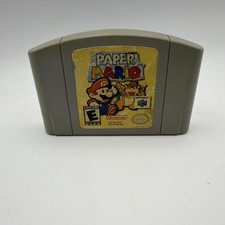
Paper Mario - Nintendo 64 (N64) Cartridge Only Tested Working
$70.99 USD
Shipping calculated
★ 99.3% · 582 ratings
Paper Mario (N64) · 9/25/2026 9:53 PM

Paper Mario, (Nintendo 64, 2001) Loose Cart Only Tested Working
$76.99 USD
Shipping calculated
★ 99.9% · 1,725 ratings
Paper Mario (N64) · 9/25/2026 8:32 PM
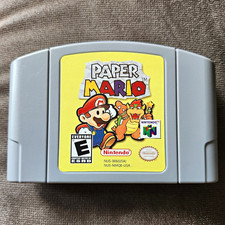
Nintendo 64 N64 Paper Mario Authentic, Tested
$79.99 USD
Shipping calculated
★ 100% · 220 ratings
Paper Mario (N64) · 9/25/2026 5:07 PM

Nintendo Paper Mario - Nintendo 64 N64 -Cartridge Only- Tested Working Authentic
$79.99 USD
+$6.49 shipping
★ 99.8% · 435 ratings
Paper Mario (N64) · 9/24/2026 11:27 PM
FAQ
How much is Paper Mario (N64) worth right now?
How often do qualifying deals appear?
Is Paper Mario (N64) reproduced or commonly faked?
More from this franchise
More Nintendo 64 deal pages
Embed this price badge

Data freshness: last snapshot 2026-09-26 00:00 UTC .