




EarthBound (SNES) — Price Guide & Live Deals
Live US EarthBound SNES deals: loose, Big Box CIB and graded asking prices, how to spot repro carts, and what the Player's Guide adds to a CIB.
Right now: prices climbing (+186.1% / 90d), 5 current qualifying listings.
See 5 qualifying listings nowAsking-price ranges by condition
| Condition | Min | 25% | Median | 75% | Max | N |
|---|---|---|---|---|---|---|
| Loose | $385.00 | $385.00 | $385.00 | $385.00 | $399.99 | 2 |
| Cib | $2,190.00 | $2,190.00 | $2,190.00 | $2,690.00 | $2,690.00 | 4 |
| Sealed | $199.99 | $199.99 | $199.99 | $199.99 | $199.99 | 1 |
Asking prices of currently-active listings. Not sold-price data.
Is this a good price?
Enter a price to see where it falls among current CIB asking prices for EarthBound (SNES).
How we filter
Of the 178 listings we observed for this game in the last 30 days, we filtered out 118 of 178 (~66%) for quality reasons. The remaining 60 are what we'd actually surface.
- 103 matched a bootleg / out-of-scope keyword
- 10 seller had too few feedback ratings
- 2 wrong condition (e.g. parts-only)
- 2 priced below our floor (too good to be true)
- 1 priced above the curated ceiling
EarthBound shipped on the Super Nintendo in June 1995, developed by HAL Laboratory and Ape Inc. and published by Nintendo. It is the US-localized release of the Japanese title Mother 2 (Super Famicom, 1994) and the second entry in the Mother series. The cart underperformed at retail when new but became a cult favorite over the following decades, and its CIB now sits among the most consistently sought-after Super Nintendo packages on the secondary market — primarily because the original release shipped in an oversized "Big Box" that included a full-color Player's Guide, an unusual CIB inclusion for a Nintendo first-party SNES title of the era. The feed below pulls current eBay listings that match the original US-NTSC SNES release, filtered to authentic-claim sellers with a meaningful feedback history. Pick a condition chip — All, Loose, CIB, or Sealed — to scope what's shown; the editorial below explains what each tier should actually include and what to verify before buying.
What the EarthBound feed shows (and what it doesn't)
The deals on this page surface the original 1995 US-NTSC Super Nintendo release. They deliberately filter out:
- Japanese Super Famicom imports — the Japanese release is titled Mother 2: Giygas Strikes Back (the EarthBound rename was a US localization choice), ships on Super Famicom hardware (Nintendo's domestic name for the SNES platform), and uses different cart-shell geometry that won't fit a US SNES without an adapter. Sellers occasionally cross-list these as "EarthBound" with "Mother 2" in the description. The feed excludes
super famicom,famicom,shvc,japan,japanese,jpn,ntsc-j, and whole-wordjp. If you specifically want the Japanese release, search for it separately — different SKU, different market. - The Mother sibling titles — Mother (Famicom, Japan-only 1989; re-released to the West as EarthBound Beginnings digitally in 2015) and Mother 3 (Game Boy Advance, Japan-only 2006, fan-translated to English by the homebrew community) are distinct SKUs on different hardware. The feed excludes
mother 1,mother 2,mother 3,beginnings, and1+2(the Japanese Mother 1+2 GBA compilation, 2003). - Famous ROM hacks distributed on aftermarket flash carts —
EarthBound Halloween Hack(also distributed as Radiation's Halloween Hack: I Miss You, a horror modification of the original ROM) and the EarthBound Uncut homebrew sold by reseller "Flashback Entertainment" both ship as flash-cart products that physically fit a US SNES and that some sellers list under the EarthBound name. They are not authentic Nintendo / HAL / Ape product. The feed excludes them by name. - Reproduction carts. EarthBound has one of the more active retro-cart counterfeit scenes given its loose asking-price tier — the feed excludes self-disclosed
repro,reproduction,aftermarket,bootleg,counterfeit,knockoff,homebrew, and whole-wordrepo, but a dishonest seller listing a fake as authentic still reaches the feed. Verification work is on you; see the spotting-reproductions section below. - "For Display Only" / FDO retail-promo boxes. Nintendo shipped empty display boxes to retailers in 1995 to advertise the upcoming release; these are collectible in their own right (some graded by WATA as a separate collectible category) but contain no cart, no inserts, and have "FOR DISPLAY ONLY - NOT FOR RESALE" printed on them. They are not playable CIB copies and trade in a separate market. The feed excludes
display only,for display,fdo,unfolded,news display,promo display,grading worthy. - Standalone Player's Guide listings, manuals-only, boxes-only, and Scratch-N-Sniff-cards-only listings. The Player's Guide and its inserts trade actively as separate collectibles (the guide alone asks $250–$1500 depending on Scratch-N-Sniff card presence). The feed scopes to playable-cart listings; a guide-only listing won't appear here even though it shares the EarthBound name.
- Merchandise, dioramas, ornaments, magnets, rulers, fan art prints, metal signs, and other novelty items. EarthBound has a strong fan-merchandise market (Ness / Paula / Jeff / Poo character merchandise, Onett / Magicant location dioramas, Mr. Saturn collectibles) that frequently uses the EarthBound name in titles. The feed is the cartridge market, not the surrounding collectibles.
- The Game Boy Advance, Wii U Virtual Console, and Nintendo Switch Online re-releases. Mother 1+2 was a Japan-only GBA compilation; EarthBound itself was re-released digitally on Wii U Virtual Console (2013) and on Nintendo Switch via Nintendo Switch Online + Expansion Pack. These are not physical SKUs and aren't part of the cart market.
Asking prices in the live feed reflect what sellers are asking in this snapshot. Actual sold values can run lower (especially after offer negotiation on CIB tier) or higher (rarely; EarthBound has tight price discovery given its high visibility).
EarthBound: loose vs CIB vs sealed
Loose for EarthBound on SNES is a bare cartridge — no box, no manual, no Player's Guide, no Scratch-N-Sniff cards. The spread comes from cosmetic label condition (the original cart label uses a vibrant multi-color print that is particularly prone to fade and sticker residue), save-battery state (covered in its own section below), and authenticity claims. Loose EarthBound consistently asks among the highest of any standalone SNES game cartridge — meaningfully above contemporary SNES RPGs (Chrono Trigger, Final Fantasy VI, Secret of Mana, Super Mario RPG) — because it had a relatively limited US print run, demand has compounded over decades of cult-classic status, and the loose-cart counterfeit market makes authenticated copies command a premium.
CIB ("Complete In Box") for EarthBound is the headline tier for this title because of the original Big Box packaging. Unlike most SNES first-party releases (which shipped in standard-sized boxes containing only the cart, cardboard tray, manual, and standard Nintendo paperwork), EarthBound shipped in an oversized retail box designed specifically to contain the full-color Player's Guide as a CIB inclusion. A true Big Box CIB for this title means: the original oversized outer box, the cardboard inner tray that holds the cart, the cartridge, the instruction manual, the Player's Guide, the Scratch-N-Sniff cards bound inside the Player's Guide, and the standard Nintendo paperwork inserts of the era. CIB asking prices sit a tier well above any other SNES RPG CIB because (a) the Big Box is more fragile than a standard SNES box due to its size, (b) the Player's Guide is itself a separately-valuable collectible that's often missing from "CIB" listings, and (c) the Scratch-N-Sniff cards are frequently missing or damaged even when the guide is present. Listings that say "CIB with guide" / "Big Box complete" / "with Player's Guide" / "w/ Scratch-N-Sniff" are signaling the full-completion tier; listings that say "CIB" alone without specifying the guide are usually CIB-minus and ask below true complete. The asking-price spread between CIB-with-guide and CIB-without-guide is meaningful enough that verifying the guide's presence in the listing photos is the single most decisive completeness check at this tier.
Sealed for EarthBound is almost exclusively graded by WATA / VGA / CGC / PSA at this point. The chip filter on this page caps the Sealed bucket at $8,000 — enough room for typical mid-grade graded copies (CGC 9.0, WATA 8.5 raw-cart or mid-grade Big Box slabs), but top-grade investment-tier sealed Big Boxes (WATA 9.4+ / CGC 9.6+) trade well above and are outside this surface. Raw factory-sealed EarthBound copies essentially do not exist outside graded slabs at this point in the market — a raw sealed listing without grading-house authentication should be approached with skepticism, not enthusiasm. The Sealed bucket will frequently be thin or empty in this snapshot; the high-grade market is small and active listings are sparse.
Spotting reproductions, ROM hacks, and reseller-branded homebrew
EarthBound has one of the most active SNES-cart counterfeit and ROM-hack ecosystems on the platform because (a) loose-cart asking sits in the $300–$700 range — well above the threshold for economically-viable bootleg production, (b) the ROM is well-documented and easy to flash to aftermarket SNES-form-factor hardware, and (c) the cult-classic status drives strong demand for both fan modifications and outright counterfeits.
- Reproduction carts with "authentic" titles. The most common pattern: a flash cart in a generic SNES shell with a counterfeit EarthBound label, listed at slightly-below-market asking. The feed excludes self-disclosed
repro/reproduction/aftermarket/bootleg/counterfeit/knockofflistings, but a dishonest seller listing a fake as authentic reaches the feed. Watch for: label printing that's too crisp / too matte / too glossy compared to a 30-year-old factory label, label color saturation that's noticeably off from a reference photo, a back-of-cart screw that isn't the original Nintendo security screw (a Phillips head on the back means the cart has been opened — could be a legitimate save-battery swap, could be a reshell, could be a bootleg), shell color that doesn't match standard SNES grey, and asking prices unusually below the loose-cart median. - Fan ROM-hack carts. EarthBound Halloween Hack (also distributed as Radiation's Halloween Hack: I Miss You) is a well-known horror modification of the original ROM that has been pressed onto flash hardware by various distributors. The feed excludes it by name. Sellers occasionally distribute other EarthBound-derived ROM hacks (difficulty mods, randomizers, partial translations) under similar disguises; if a listing's title says any modifier other than "EarthBound" alone alongside the cart name, treat it as a hack unless the seller's description makes the situation explicit.
- Reseller-branded homebrew (e.g. EarthBound Uncut by Flashback Entertainment). Some resellers press homebrew or modified ROMs onto flash carts under their own brand names and list them with "COMPLETE w/ Box" phrasing that defeats casual title-text filtering. The honest ones disclose the homebrew status in the description body even when the title looks legitimate. The feed excludes the
flashback entertainmentbrand and theuncutsuffix specifically because this pattern surfaced on this title; if you see any unusual "version" / "edition" suffix in an EarthBound listing title, click through and read the full description before bidding. - Reshells / custom shells / aluminum housings. Some loose-cart listings disclose that the original PCB has been transplanted into a non-Nintendo housing (the board may be authentic Nintendo / HAL / Ape, but the cart is no longer in collector-grade factory state). The feed excludes self-disclosed
custom case/aluminum shell-style language where it appears. If a listing photo shows a cart that doesn't match a standard SNES grey shell, treat it as reshelled regardless of the title's authenticity claims. - Photo evidence to ask for. A trustworthy seller at the loose-cart asking tier can show: front of cart label (clean photo, in focus), back of cart label, back of cart with the security screw visible, and a photo of the cart booting to the EarthBound title screen on real SNES hardware. Three minutes of seller-photo work resolves most authenticity concerns short of opening the cart.
Save behavior and the cart battery
EarthBound saves to battery-backed SRAM on the cartridge, the standard SNES save architecture for RPGs of the era. The internal coin-cell battery powers a save-data RAM chip; when that battery dies, your save file is lost on the next power cycle. The cart itself plays fine without a battery — the SRAM only matters for save persistence, not gameplay — but for an RPG with a 25–30 hour main story, save reliability is decisive.
Practical buyer-decision implications:
- "New save battery" / "battery replaced" listings give you a real signal. A seller who explicitly swapped the battery is telling you the cart will hold saves for another 15-20 years. Listings that only say "tested" — without specifying that saves were tested across multiple power cycles — give you less.
- "Dry battery" / "battery dead — won't save" listings still play through the entire game. The cart works for active play; you just can't power-off and resume. These listings are legitimate and asking-priced below tested-saves examples; if you intend to swap the battery yourself, this can be the better deal.
- Battery-replacement premium discipline. "Battery replaced" with a date ("replaced 2025") is a different signal than "battery replaced" with no date. The replacement clock starts when the cell was swapped, not when the cart was made.
- DIY swap cell type. The exact coin-cell spec varies across SNES PCB revisions and isn't worth guessing remotely — if you plan the swap yourself, open the cart with the appropriate Nintendo security driver and verify the cell type against the visible markings before ordering replacements.
EarthBound verification checklist by condition
Loose
- Confirm the cartridge shape matches a standard US Super Nintendo cart (tall rectangular shell with curved top ridges). Smaller / squarer shapes are Japanese Super Famicom carts.
- Look at the back-of-cart label and confirm the product code prefix. Authentic US SNES retail carts use the
SNS-product-code prefix (Japanese Super Famicom usesSHVC-). A clean back-label photo is the definitive structured signal. - Confirm the back-of-cart screw is the original Nintendo security screw (not a Phillips head). Phillips on the back means the cart has been opened — could be a legitimate save-battery swap, could be a reshell, could be a bootleg. Verify against the seller's photos and ask for the cart-open photo if you're paying the upper end of the tier.
- Look for label condition: tears, water damage, residue from price stickers, off-color background, label paper that looks too new for a 30-year-old cart, label print that's too crisp or too uniform compared to a reference photo of a known-authentic cart.
- Ask whether saves have been tested across multiple power cycles and what specifically the seller verified. "Tested working" can mean a 30-second power-on check; "tested saves, powered off, came back, save loaded" is the actionable signal for a 25-hour RPG.
- Treat an EarthBound loose asking sharply below the broader market median as the strongest single repro-or-misrepresentation signal short of the seller saying so. The loose counterfeit market for this title is large enough that "too-good-to-be-true" pricing is a near-perfect bootleg tell.
CIB
- Confirm the box is the original oversized Big Box (not a standard SNES box, and not a "replacement box" — the aftermarket reproduction-Big-Box market exists for CIB-assemblers). The feed filters
replacement box onlylistings out, but verify against the listing photos that the box is original. A Big Box is noticeably larger than a standard SNES box; a CIB listing showing a standard-sized box is signaling either a misrepresented listing or a CIB-minus reseller assembly. - Confirm the cardboard inner tray that holds the cart is present and matches an authentic Nintendo tray (white-finish printed cardboard, not a re-fabricated reseller tray).
- Confirm the instruction manual is present and not a photocopy or modern reprint.
- The Player's Guide is the decisive completeness item for this title's CIB tier. It is the full-color strategy guide that originally shipped INSIDE the Big Box as a CIB inclusion (not a separately-marketed Nintendo Power-style strategy guide that buyers had to acquire separately). Listings that say "no guide" / "missing guide" / "without Player's Guide" are CIB-minus and ask meaningfully below true complete. Listings that say "with guide" / "w/ Player's Guide" / "complete with guide" are the full-CIB tier — verify the guide is in the listing photos rather than just claimed in the title.
- The Scratch-N-Sniff cards bound inside the Player's Guide are the second-decisive completeness item. Sellers sometimes describe these as "Scratch-N-Sniff stickers" or "Scratch-N-Sniff cards" — both refer to the same scented inserts that originally shipped within the Player's Guide. Listings that say "with Scratch-N-Sniff" / "Scratch-N-Sniff cards present" are the full-completion signal; "guide complete, no Scratch-N-Sniff" is a CIB-minus tier within the with-guide bucket; "one missing sticker" / "scent faded" are common condition issues that ask below true mint.
- Box wear (corner crush, label fade, tape residue, sun-bleaching on the spine, indented original-retailer price stickers) drives the spread in CIB asking prices, and the Big Box's larger surface area amplifies the visual impact of any single condition issue compared to a standard-sized SNES box. Listings that show the box from one flattering angle may be hiding damage on the other faces — ask for photos of all six sides if you're paying the upper end of the tier.
- The standard Nintendo paperwork inserts of the era (consumer-precautions card, registration / Nintendo Power subscription material) shipped alongside the Player's Guide inside the Big Box; contents varied across print runs and aren't separately verified against a canonical reference for this title.
Sealed (graded)
- Almost always graded — verify the grading slab is from a reputable house (WATA, VGA, CGC, PSA), the grade is readable in the listing photos, and the certification number is visible.
- Cross-check the cert number against the grading house's online lookup if you're paying meaningfully into the tier.
- Counterfeit-PCB carts have been reshelled and re-sealed into convincingly-presented Big Boxes for the sealed-grading market. Sealed copies that haven't been through a reputable grading service deserve extra scrutiny — a raw sealed EarthBound at a market-rate asking price is highly unusual and should be approached with skepticism, not enthusiasm.
- The feed caps the Sealed bucket at $8,000. Top-grade investment-tier sealed Big Boxes (WATA 9.4+ / CGC 9.6+) trade well above and are outside this surface — for serious sealed buying at the high-grade tier, shop with auction houses that specialize in graded sealed games.
EarthBound buying gotchas
- The Player's Guide question dominates CIB asking-price discovery. No other SNES CIB has this dynamic; for most SNES titles, the manual is the only paper insert that affects price discovery meaningfully. For EarthBound, the Player's Guide and its Scratch-N-Sniff cards are two distinct completeness items each worth significant asking-price differentials. "CIB" alone in a title is ambiguous for this game in a way it isn't for most.
- Standalone Player's Guide listings ask near loose-cart prices. The Player's Guide is collectible separately and asks $250–$1500 depending on Scratch-N-Sniff card presence and overall condition. These listings get filtered out of this surface (the page is the cart market, not the guide market), but the asking-price overlap means it's easy to mistake a guide-only listing for a CIB listing on a quick scan elsewhere on eBay. If you're shopping outside this feed, verify the title says "cart" / "cartridge" / "CIB" / "complete" — a title that only says "EarthBound Player's Guide" is the guide, not the cart.
- Reproduction carts at "authentic" prices. Asking prices sharply below the loose-cart median are a strong repro signal; asking prices roughly at-market with no clear authenticity photos are a softer signal worth asking about. Don't pay loose-cart asking for a cart you can't authenticate from the listing photos alone.
EarthBound Halloween Hackand other ROM-hack carts. These are legitimate fan projects but are NOT authentic Nintendo / HAL / Ape product. They ship on aftermarket flash carts in SNES form factor with custom labels. The feed excludes them by name; verify any unusual-titled EarthBound listing isn't a hack-cart before buying.- Reseller-branded homebrew like
EarthBound Uncutby Flashback Entertainment. Some resellers press unofficial / modified ROMs onto flash carts under their own brand names. The honest ones disclose the homebrew status in the description body. If you see any unfamiliar "version" / "edition" / brand suffix in an EarthBound listing title, click through and read the full description before bidding. - "For Display Only Box" / FDO retail promo material. Nintendo shipped empty display boxes to retailers in 1995; these are collectible (sometimes graded by WATA separately) but contain no cart and trade in their own market. The feed excludes them so the cart-CIB asking-price percentiles stay accurate.
- "Made in Japan" notation on US carts. Some authentic US EarthBound carts carry "Made in Japan" on the back-label country-of-origin stamp because Nintendo / HAL produced some of the US-NTSC cartridge inventory at Japanese facilities for export to the US market. This is NOT a signal that the cart is a Japanese Super Famicom import — the cart shape, the SNES product-code prefix, and the English label are the region-identification signals; the manufacturing-origin stamp is a separate piece of information.
- CGC / WATA / VGA / PSA grading-house abbreviations. Listings titled with grading-house initials and a numeric grade (e.g.
CGC 9.0,WATA 8.5) are encapsulated graded copies, not raw sealed. Raw factory-sealed EarthBound SNES copies essentially do not exist outside graded slabs at this point in the market. - Multi-game SNES RPG lots and sibling-franchise bundles. EarthBound frequently appears bundled with Chrono Trigger, Final Fantasy VI, Secret of Mana, Super Mario RPG, Breath of Fire, or other SNES RPGs. Lot listings get filtered out so per-game asking prices stay accurate; the feed excludes
lot,bundle,collection, andset ofalong with the sibling-franchise tokensmother 1/mother 2/mother 3/beginnings/1+2. - Refurbished-suffix condition variants. Some sellers mark cleaned or board-worked carts as
Very Good - Refurbished/Excellent - Refurbished/Good - Refurbishedrather than the standardVery Goodcondition. The feed treatsRefurbishedas a distinct condition not included in this page's standard pool — refurbished work (replacement boards, reshells, save-chip swap, pin cleaning beyond contact cleaner) is a yellow flag for collectors and the asking-price tier on this page reflects authentic-original carts. If you specifically want a refurbished cart, search separately. - Seller feedback floor. The deal feed requires the seller to have ≥50 feedback at ≥99% positive. Low-feedback sellers with cheap EarthBound listings are a recurring fraud vector on a title with a strong counterfeit market — the feed quietly drops them, but the same heuristic protects you if you're shopping outside this surface.
How often qualifying deals appear
- 22 in the last 7 days (~3.14/day)
- 69 in the last 30 days (~2.3/day)
- 153 in the last 90 days (~1.7/day)
Current qualifying listings

Nintendo EarthBound SUPER NES SNES Cartridge Only Authentic Tested
$350.00 USD
Shipping calculated
★ 100% · 386 ratings
EarthBound (Super Nintendo, US NTSC) · 9/26/2026 7:58 PM

Earthbound SNES Cartridge Only AUTHENTIC TESTED SAVES Super Nintendo Very Good
$523.91 USD
Shipping calculated
★ 99.9% · 4,042 ratings
EarthBound (Super Nintendo, US NTSC) · 9/26/2026 1:26 PM
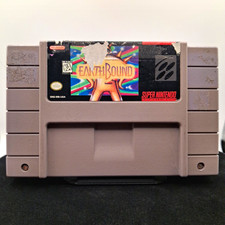
EarthBound Nintendo SNES Cartridge Only, Authentic, Still Saves!
$350.00 USD
Shipping calculated
★ 100% · 1,227 ratings
EarthBound (Super Nintendo, US NTSC) · 9/26/2026 4:46 AM

Nice! Earthbound Super Nintendo Authentic Game Near Complete In Box Guide CIB
$2,690.00 USD
Free shipping
★ 100% · 12,771 ratings
EarthBound (Super Nintendo, US NTSC) · 9/24/2026 11:41 PM

Earthbound Super Nintendo Authentic Game Near Complete In Box Guide CIB
$2,190.00 USD
Free shipping
★ 100% · 12,771 ratings
EarthBound (Super Nintendo, US NTSC) · 9/24/2026 11:41 PM
FAQ
How much is EarthBound (SNES) worth right now?
How often do qualifying deals appear?
Is EarthBound (SNES) reproduced or commonly faked?
More Super Nintendo deal pages
Embed this price badge

Data freshness: last snapshot 2026-09-26 00:00 UTC .