




Super Mario 64 (Nintendo 64) — Live Deals & Price Guide
Live US-NTSC Super Mario 64 Nintendo 64 deals across loose carts, CIB, and graded sealed. What a fair asking price looks like, how to spot reproductions, and which sub-buckets (Player's Choice, signed, NFR demo) carry their own premiums.
Right now: prices climbing (+29.7% / 90d), 12 current qualifying listings.
See 12 qualifying listings nowAsking-price ranges by condition
| Condition | Min | 25% | Median | 75% | Max | N |
|---|---|---|---|---|---|---|
| Loose | $19.95 | $38.00 | $39.99 | $45.99 | $90.32 | 26 |
| Cib | $120.00 | $120.00 | $128.68 | $128.68 | $169.99 | 3 |
| Sealed | $11.99 | $11.99 | $11.99 | $11.99 | $11.99 | 1 |
Asking prices of currently-active listings. Not sold-price data.
How we filter
Of the 1325 listings we observed for this game in the last 30 days, we filtered out 944 of 1325 (~71%) for quality reasons. The remaining 381 are what we'd actually surface.
- 772 matched a bootleg / out-of-scope keyword
- 93 seller had too few feedback ratings
- 35 shipped from a region we exclude
- 22 seller positive-feedback percentage too low
- 12 RequiredAspect
- 5 priced above the curated ceiling
- 3 priced below our floor (too good to be true)
- 2 wrong condition (e.g. parts-only)
What you're looking at
Live eBay listings for Super Mario 64 on Nintendo 64 — the US-NTSC 1996 release that launched alongside the console itself and the analog Control Stick. Developed by Nintendo EAD and published by Nintendo, Super Mario 64 was the first fully 3D Mario platformer, built around 120 Power Stars hidden across 15 painted-world stages plus the hub of Princess Peach's Castle. It defined how 3D character action worked for the rest of the era, and the cartridge has been one of the most actively-traded N64 titles in collector channels since the late 2000s retro-resurgence.
The deal feed below surfaces the original Nintendo 64 cartridge. It deliberately filters out the Super Mario 64 DS remake on Nintendo DS (2004) — same title text, completely different hardware — because search-text overlap is heavy enough that a US-NTSC N64 buyer often sees DS cart listings polluting their results. Switch-era digital re-releases (Super Mario 3D All-Stars in 2020, the Switch Online + Expansion Pack N64 catalog since 2021) are not in the feed because they aren't physical N64 carts; if your goal is just to play the game, the subscription is the cheapest path and skips the cartridge-authenticity question entirely. The N64-cart market exists because collectors and original-hardware players want the cartridge.
Use the condition chips above the deal grid to bucket what's surfaced:
- Loose — cartridge only, the deepest bucket on this page.
- CIB — complete-in-box: cartridge plus outer box, inner cardboard tray, and instruction manual.
- Sealed — factory-sealed or graded encapsulated copies. Almost always graded by WATA / VGA / CGC / PSA.
Asking-price numbers in the table render from current active US listings. They are seller asks, not realized sale prices. Treat them as the buyer's negotiating floor, not the appraisal.
Variants worth knowing
The substantive variants for the US-NTSC Nintendo 64 release of Super Mario 64 are by print run and by sub-market:
- US NTSC original print (NUS-006 USA) — the launch SKU, late September 1996. The cartridge label and box list 1996 as the release year. This is the bulk of what the feed surfaces.
- US Player's Choice reprint — a later Nintendo budget reprint with a distinct red-banded Player's Choice label and box treatment. Frequently listed with a 1999 print-year stamp. Functionally identical to the original print; the box-art differences are minor (the Player's Choice band on the front and back) and collector preference for the original print is more about box presentation than gameplay or contents. Both surface on this page; the chip filter doesn't separate them.
- "Not For Resale" promotional / kiosk carts — Nintendo distributed a small number of loose carts marked "NOT FOR RESALE" to retailers as display / demo units. These are genuine Nintendo carts and trade at a meaningful premium over standard loose carts because of their relative scarcity, not because of any gameplay difference. The feed surfaces them when sellers list them in the standard condition pool — you'll see them flagged with the "Not For Resale" phrase in the title.
- Charles Martinet (Mario's voice actor) autographed CIB copies — a recurring premium sub-bucket. The autograph is what carries the price, not the cart or box. These typically ship with third-party authentication (Beckett, JSA, PSA/DNA) — verify the authentication separately from the cart authentication.
- Japan / Europe / Australia (PAL) variants — excluded. The Japanese release (NUS-NSMJ-JPN, including the JP-only Shindou Edition that adds Rumble Pak support) and the PAL European releases are different SKUs with different region locks; the feed filters by region keywords and item-location country. If you specifically want a JP or PAL copy, search separately.
Listings prefixed with bracketed "Supports Rumble Pak" wording are typically Japan-origin Shindou Edition carts; the US release does not support the Rumble Pak. The feed excludes the rumble pak phrase alongside the explicit region keywords.
Loose vs CIB vs sealed for this title
Loose is the deepest bucket on this page. Super Mario 64 was the N64's pack-in / launch title and shipped in enormous volume — far more than most collector-tier N64 RPGs — so the loose-cart supply is steady and asking prices sit in the low- to mid-double digits for a typical authentic tested copy. The spread within the loose bucket comes from label condition, claimed authenticity, and how specifically the seller describes their testing.
CIB copies are meaningfully scarcer than loose but still trade more frequently than CIB copies of contemporary low-print N64 RPGs. A Super Mario 64 CIB typically includes the outer cardboard box, the cardboard insert tray that cradles the cartridge, the instruction manual, and the standard Nintendo paperwork inserts of the era. The CIB asking-price gradient is primarily driven by box wear (corner crush, label fade, edge tears, indented original-retailer price stickers, sun-bleaching of the spine) and insert completeness. Partial-CIB listings — box and cart present but manual missing, or box but no tray — show up frequently and should price below a true complete copy; explicit "no manual" / "no tray" notes in the title are the signal.
Sealed copies are dominated by third-party graded slabs (WATA, VGA, CGC, PSA). Raw factory-sealed copies of a 29+ year-old cart are vanishingly rare and difficult to authenticate without a grader; most "sealed" listings on this page are graded encapsulated copies. Graded asking prices for Super Mario 64 climb steeply with grade — typical mid-grade graded copies fall under the page's Sealed cap, but the top-grade investment tier (WATA 9.4 A+ / 9.6 / CGC 9.8) trades well above and falls outside this surface. The Sealed chip may show no current matches when the graded-sealed market is thin in a snapshot; the price summary still reflects the historical asking range.
Spotting reproductions and bootlegs
Super Mario 64 is counterfeited at meaningful volume — the title's mass-market visibility, well-circulated ROM, and the $30+ loose-cart asking tier together make bootleg cart production economically attractive. N64 cartridge bootlegs are physically larger than Game Boy / GBA cart bootlegs and harder to fake convincingly, but the surface still gets a steady stream of "authentic Super Mario 64" listings that are actually reproductions. The deal feed filters out listings that self-identify as repro, reproduction, or aftermarket (plus the collector-shorthand repo whole-word exclude) — but a dishonest seller listing a bootleg as "authentic" will reach the feed. The physical verification work is on the buyer.
The most reliable physical tells, in rough order of reliability:
- Cartridge screw on the back. Authentic Nintendo 64 cartridges use a specific Nintendo security screw — not a standard Phillips head. A Phillips-head (cross-shaped) screw on the back of a Super Mario 64 cart means the cart has been opened (legitimate cleaning / save-chip work) OR is a bootleg / aftermarket reshell. Phillips on the back is not by itself proof of fake, but it is a flag that the cart's interior is no longer factory-original. Verify the screw type against a high-resolution photo of a known-authentic N64 cart before treating it as the deciding factor; don't trust a generic "N64 uses screw X" claim from a single source.
- Label print quality and color saturation. Authentic Super Mario 64 labels have crisp, evenly-saturated multi-color printing with consistent registration of the manufacturer-info bar at the bottom of the label. Smudged ink, off-center placement, washed-out colors, label paper that feels too glossy or too matte versus a verified reference, or labels that look "newer than the cart" all suggest aftermarket. Reproduction labels are the single most common N64 counterfeit attack surface; high-resolution side-by-side comparison against a verified-authentic photo is the most reliable single remote-buyer check.
- Cartridge shell color and material. Standard Super Mario 64 carts use a black plastic shell. Off-color shells (the wrong shade of black, translucent variants, custom colors) almost always indicate a reshell or aftermarket cart — Nintendo did not release Super Mario 64 in alternate shell colors, and a custom shell pairs with an opened cart by definition.
- Cartridge weight and PCB. If you can request an interior photo (cart open), authentic Super Mario 64 PCBs have specific component layouts and chip markings that bootleg boards rarely match exactly. Sellers willing to send an interior photo on request are usually the more trustworthy ones. Be aware that opening a cart voids the factory-original state if the seller hasn't already opened it — only ask if the seller has already opened or photographed the interior.
- Save behavior on real hardware. Many bootlegs save fine in single sessions but fail to retain saves across power cycles, or save in ways that don't preserve all game state (lost stars, lost progression). Ask whether the seller has actually played far enough to confirm saves persist across power-off cycles.
There's a Super-Mario-64-specific outlier-cheap signal worth noting: listings priced sharply below the broader market median (the $20-something "Brand New" tier) are nearly always dropshipped replicas or grey-market generic carts — frequently with a Super Mario N64 (no "64" in the game-name slot) item-specifics field that gives them away on the back end. Authentic Super Mario 64 at any condition does not trade at the dropship price tier in the US market.
Save behavior: EEPROM, not battery
Unlike Game Boy / Game Boy Color carts and many of the contemporary RPG-era N64 carts, Super Mario 64 stores saves in an internal EEPROM chip, not battery-backed SRAM. There is no coin-cell battery on the Super Mario 64 PCB that can die and erase your save file. EEPROM does have a finite write-cycle lifetime, but the practical implication is that 30-year-old Super Mario 64 carts retain their save behavior far more reliably than battery-backed contemporaries — "save battery" or "needs new battery" disclaimers in a Super Mario 64 listing are signals of a seller who's copy-pasted boilerplate from a battery-game listing template, not signs of a defect on this particular cart.
What can still go wrong on a 30-year-old EEPROM cart: bit-rot on the save chip itself (rare but possible), corroded cartridge contacts (cleanable), and the standard mechanical wear on the shell. The buyer-decision-driving question for Super Mario 64 specifically is whether the cart's contacts are clean enough to maintain a stable boot — sellers who specifically mention "pins cleaned" or "tested boot to title screen and beyond, save creates and persists" are giving you the actionable signal. "Tested" without describing what was tested is weaker.
Verify EEPROM specifics against a current PCB photo before ordering any replacement components — different N64 titles use different save methods and PCB revisions, and confusing one for another is a common LLM-confusion zone the editorial deliberately avoids enumerating cart-specific component IDs for.
Per-condition verification checklist
Loose
- Confirm the back-of-cart screw is the original Nintendo security screw (not Phillips). Phillips = opened or aftermarket — ask why before treating the cart as authentic.
- Inspect the label: tears, water damage, residue from old price stickers, missing label edges, signs of label replacement, off-color printing. Compare against a known-authentic Super Mario 64 label photo at high resolution.
- Confirm the cartridge shell is the standard black plastic shell (off-color shells are aftermarket).
- Ask whether the seller has tested saves across multiple power-cycles, and what specifically was tested. For Super Mario 64 specifically, "creates a new file, saves after a star, powers off and back on, file loads with the star intact" is the gold-standard test.
- "Authentic" should be stated explicitly. "Tested" should specify what was tested.
- Treat any loose Super Mario 64 asking sharply below the broader market median as a flag for closer inspection — the dropship-replica pattern is the strongest single repro-or-misrepresentation signal on this title.
CIB
- Confirm the outer cardboard box is present (not a "replacement box" reproduction). The feed actively filters
replacement boxlistings — these are aftermarket reproductions of the original packaging sold to CIB-assemblers and should not be priced as the original. - Confirm the inner cardboard tray that cradles the cartridge — a meaningful piece of "complete" and frequently missing on partial CIBs.
- Confirm the instruction manual is present, not a photocopy or modern reprint. The feed excludes
manual copy,mail order,photocopy, andphoto copylistings, but always verify against the listing photos. - Confirm any paper inserts are present (the standard Nintendo paperwork of the era — specific contents varied by print run, so verify against a reference photo if completeness matters to you).
- Box wear (corner crush, label fade, tape residue, sun-bleaching of the spine, indented original-retailer price stickers) drives the spread in CIB asking prices. Acrylic-protector listings can hide box damage behind plastic — request photos of the actual box surfaces, not just the protected presentation.
- If the listing is a Player's Choice CIB, confirm the box is the matching Player's Choice variant (not an original-print box paired with a Player's Choice cart, which is sometimes assembled by resellers).
Sealed
- Almost always graded — verify the grading label is from a reputable house (WATA, VGA, CGC, PSA) and the population report supports the asking price.
- Cross-check the cert number against the grader's online lookup if you're spending into the four figures.
- Be especially wary of acrylic-protector listings that look like graded slabs but aren't — graded slabs are tamper-sealed plastic with the grader's serial on the front and a holographic back label.
- The sealed market is where forgery risk is highest. Counterfeit-PCB carts have been reshelled and re-sealed into convincingly-presented "raw sealed" boxes; raw sealed copies that haven't been through a reputable grading service deserve extra scrutiny.
Buying gotchas
- Super Mario 64 DS confusion. The 2004 Nintendo DS remake adds Yoshi / Luigi / Wario as playable characters and 30 extra stars (150 total) but is a different game on different hardware. The feed structurally excludes
dsas a whole-word title token, so DS listings are filtered out of the N64 cart pool — but if you specifically wanted the DS remake, search separately. The DS remake is unrelated to the N64 cart authenticity / asking-price discussion on this page. - JP Shindou Edition slip-throughs. The Japan-only Shindou Edition (released July 1997) adds Rumble Pak support and patches several bugs from the original release. JP-origin sellers occasionally list Shindou carts in English with "Supports Rumble Pak" as the discriminator, sometimes without the word
JapanorShindouin the title. The feed excludesrumble pak,shindou, plus item-location country JP/HK/CN. If you specifically want a Shindou cart, search separately and verify the seller's region directly. - Generic dropship "Super Mario N64" listings. A pattern of generic-listing dropshippers post
Super Mario N64 For Nintendo 64orN64 Video Games Super Mario 64 For Nintendo 64 console US Versionat sub-market Brand New prices ($20-$30). The Item Specifics frequently hasGame Name: Super Mario N64rather thanSuper Mario 64— the feed's aspect-lock filter catches these in production polling but can't guarantee catch on every preview snapshot due to a per-cycle aspect-fetch budget. The dropship pattern is the strongest single fraud signal on this title — outlier-cheap Brand New is essentially never authentic. - "Not For Resale" promo carts. Genuine Nintendo "Not For Resale" demo / kiosk carts trade at a meaningful premium over standard loose copies. They are authentic Nintendo product, not reproductions — but verify the cart matches the standard NFR aesthetic (specific label printing, no UPC barcode, sometimes a stamped or printed "Not For Resale" marking) rather than a generic loose cart that a seller has labeled "NFR" for asking-price purposes.
- Charles Martinet signed CIBs. A small market exists for Charles-Martinet-autographed Super Mario 64 boxes; the autograph carries the price, not the cart. Verify the autograph authentication (Beckett, JSA, PSA/DNA, or in-person event provenance) independently from the cart authentication. The cart inside an autographed CIB still needs the same authentication checks as any other CIB.
- Box-only / manual-only / booklet-only listings. Partial-CIB component listings show up frequently — sellers parting out a CIB into individual pieces hoping a CIB-assembler will buy each part separately. The feed excludes
manual only,box only,booklet only,book only, plusbookletas a whole-word exclude (legit CIB listings say "Manual" rather than "Booklet"). Original Nintendo Power player's guides and Prima strategy guides for Super Mario 64 also surface in the same category at $15-$50 — the feed filters them viaplayers guide,player's guide,strategy guide,nintendo power,prima,primas,official guide,guide book. - Multi-game Mario-N64 lots. Super Mario 64 is the most frequently-bundled N64 cart — it shows up paired with Mario Kart 64, Mario Party 1/2/3, Mario Tennis, Mario Golf, Paper Mario, Star Fox 64, GoldenEye, and console-bundle deals. Lot listings get filtered out so per-game asking prices stay accurate; the feed excludes
lot,bundle,collection,set of,3 games/4 games/5 games, and the Mario-sibling tokenskart,party,tennis,golf,paper. - Console-and-cart bundles. "N64 system with Super Mario 64 and two controllers" listings are excluded via
controller— if you want a console + cart bundle, that's a different shopping question with its own pricing landscape and isn't surfaced here. - Reshelled / aftermarket-shell carts. Sellers sometimes put an authentic Super Mario 64 board into a fresh aftermarket shell to ship a "cleaner-looking" cart. These are filtered out of the standard pool — but if you see "new shell", "custom shell", or "reshell" in a title that slipped through, that's the signal.
- Refurbished-suffix condition variants. Some sellers mark cleaned carts as "Very Good - Refurbished" or "Good - Refurbished" rather than the standard "Very Good" / "Good" condition values. The feed treats refurbished as a distinct condition not included in this page's bucket — refurbished work (replacement boards, reshells, save-chip replacement) is a yellow flag for retro cart collectors. If you specifically want a refurbished cart, search separately.
- Seller feedback floor. The deal feed requires the seller to have ≥50 feedback at ≥99% positive. Low-feedback sellers with cheap Super Mario 64 listings are a recurring fraud vector given the title's mass-market visibility; the feed quietly drops them, but the same heuristic is worth applying if you shop outside this surface.
How often qualifying deals appear
- 112 in the last 7 days (~16/day)
- 432 in the last 30 days (~14.4/day)
- 1298 in the last 90 days (~14.42/day)
Current qualifying listings

Super Mario 64 (Nintendo 64 N64, 1996) Authentic game Cartridge Only. Tested
$39.99 USD
Shipping calculated
★ 99.7% · 1,222 ratings
N64 Super Mario 64 · 9/18/2026 3:05 AM

Super Mario 64 (Nintendo 64, 1999)
$45.00 USD
Shipping calculated
★ 100% · 382 ratings
N64 Super Mario 64 · 9/17/2026 10:26 PM
Super Mario 64 (Nintendo 64 N64, 1996)
$39.99 USD
Free shipping
★ 99.7% · 6,013 ratings
N64 Super Mario 64 · 9/17/2026 9:24 PM

Nintendo Super Mario 64 Nintendo 64 N64 Game Cartridge NTSC-U/C (US/Canada)
$40.00 USD
+$9.61 shipping
★ 99.4% · 3,057 ratings
N64 Super Mario 64 · 9/17/2026 8:35 PM

Nintendo Super Mario 64 (Nintendo 64 N64) Game Cartridge E Rated NTSC-U/C
$60.00 USD
Free shipping
★ 99.7% · 1,386 ratings
N64 Super Mario 64 · 9/17/2026 8:12 PM

Authentic Nintendo Super Mario 64 (Nintendo 64) N64 Cartridge NTSC-U/C KA
$38.00 USD
Shipping calculated
★ 100% · 83 ratings
N64 Super Mario 64 · 9/17/2026 7:44 PM

Super Mario 64 Nintendo 64 N64 Cartridge NTSC-U/C (US/CA) 1996
$35.00 USD
Shipping calculated
★ 100% · 3,186 ratings
N64 Super Mario 64 · 9/17/2026 7:33 PM
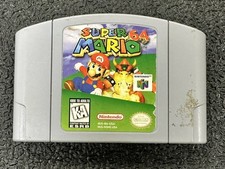
Super Mario 64 (Nintendo 64, 1996) (PD1127908)
$34.99 USD
Free shipping
★ 99.6% · 9,002 ratings
N64 Super Mario 64 · 9/17/2026 7:25 PM

Super Mario 64 (N64) – CIB – Complete w/ Manual – Box & Cart
$120.00 USD
+$9.00 shipping
★ 100% · 2,340 ratings
N64 Super Mario 64 · 9/17/2026 6:42 PM

Super Mario 64 - GAME ONLY - NINTENDO 64 - 917a
$46.99 USD
Free shipping
★ 100% · 64,528 ratings
N64 Super Mario 64 · 9/17/2026 2:20 PM

Super Mario 64 for N64 CIB Complete in Box Nintendo Super Clean Box and Cart
$128.68 USD
★ 100% · 84 ratings
N64 Super Mario 64 · 9/17/2026 1:51 PM

Super Mario 64 (Nintendo 64, 1998) Authentic Tested N64 Game
$49.00 USD
Shipping calculated
★ 100% · 2,291 ratings
N64 Super Mario 64 · 9/17/2026 2:33 AM
FAQ
How much is Super Mario 64 (Nintendo 64) worth right now?
How often do qualifying deals appear?
Is Super Mario 64 (Nintendo 64) reproduced or commonly faked?
More from this franchise
Data freshness: last snapshot 2026-09-18 00:00 UTC .